Organ3 min read
Brain
Encephalon
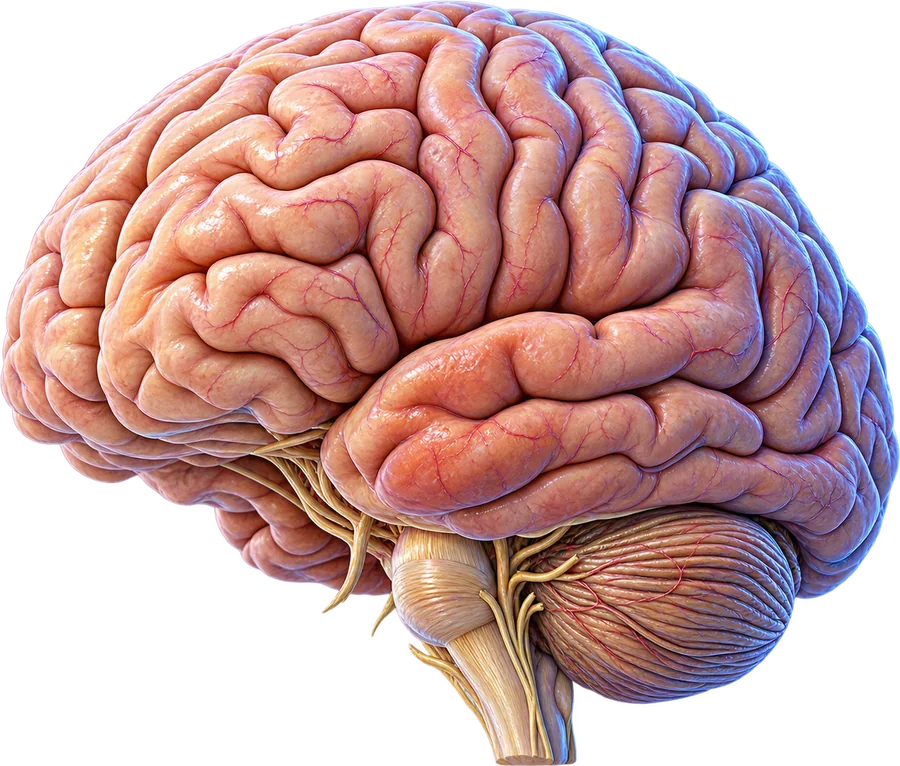
The body's control centre inside the skull: thinking, memory, speech, movement and sensation, plus breathing and heartbeat control.
The brain consists of three main parts: the cerebrum (the largest, responsible for thinking, voluntary movement, sensation and language), the cerebellum (balance and coordination of movement), and the brainstem (breathing, heartbeat and alertness). Its nerve cells communicate by electrical and chemical signals.
The cerebrum is divided into two hemispheres and four lobes: frontal (planning and movement), parietal (sensation), temporal (hearing and memory), and occipital (vision). Each hemisphere mostly controls the opposite side of the body. Neurons transmit the signal electrically within the cell, then chemically across the synapses via neurotransmitters.
What and where is it?
The brain lies inside the skull and connects to the spinal cord via the brainstem, and together they form the central nervous system within the nervous system.
What it does
| Part | Main functions |
|---|---|
| Cerebrum | Thinking, memory, language, voluntary movement, and sensation |
| Cerebellum | Balance and coordination of fine movement |
| Brainstem | Breathing, heartbeat, blood pressure, and sleep and wakefulness |
How it works
- 1ReceptionInformation arrives from the senses and body organs through the nerves.
- 2Signal within the neuronThe message travels as an electrical impulse along the nerve cell.
- 3The synapseChemical neurotransmitters are released and cross the gap to the next cell.
- 4ProcessingBrain regions integrate the information and make the decision.
- 5ResponseCommands are sent to the muscles and glands via the spinal cord and nerves.
Each hemisphere of the cerebrum mostly controls the opposite side of the body; so an injury to the left hemisphere may cause weakness on the right side.
Conditions that affect it
Tests used to study it
Assessment usually starts with a clinical neurological examination, then imaging when needed:
Keeping it healthy
- Controlling blood pressure, one of the most important risk factors for stroke.
- Physical activity, not smoking, and limiting alcohol.
- Protecting the head from injuries, such as a helmet and seat belt.
Observational studies link mental and social activity to a lower risk of dementia, but association alone does not prove that one causes the other.
When do you need urgent help?
Call emergency services now 998
Educational content only — no diagnosis, and no substitute for a clinician.
References
- 1NINDS / NIH. Brain Basics: Know Your Brain. www.ninds.nih.gov/health-information/public-education/brain-basics/brain-basics-know-your-brainHealth agencies & guidelines · Accessed 2026-10-04
- 2NCI SEER Training. Nervous System. training.seer.cancer.gov/anatomy/nervous/Educational & historical references · Accessed 2026-10-04
- 3NINDS / NIH. Brain Basics: The Life and Death of a Neuron. www.ninds.nih.gov/health-information/public-education/brain-basics/brain-basics-life-and-death-neuronHealth agencies & guidelines · Accessed 2026-10-04
- 4WHO. Stroke — Fact sheet. www.who.int/news-room/fact-sheets/detail/strokeHealth agencies & guidelines · Accessed 2026-10-04
- 5WHO. Epilepsy — Fact sheet. www.who.int/news-room/fact-sheets/detail/epilepsyHealth agencies & guidelines · Accessed 2026-10-04
- 6WHO. Dementia — Fact sheet. www.who.int/news-room/fact-sheets/detail/dementiaHealth agencies & guidelines · Accessed 2026-10-04
- 7WHO. Headache disorders — Fact sheet. www.who.int/news-room/fact-sheets/detail/headache-disordersHealth agencies & guidelines · Accessed 2026-10-04
- 8NIBIB / NIH. Computed Tomography (CT). www.nibib.nih.gov/science-education/science-topics/computed-tomography-ctHealth agencies & guidelines · Accessed 2026-10-04
- 9NIBIB / NIH. Magnetic Resonance Imaging (MRI). www.nibib.nih.gov/science-education/science-topics/magnetic-resonance-imaging-mriHealth agencies & guidelines · Accessed 2026-10-04
- 10WHO. Hypertension — Fact sheet. www.who.int/news-room/fact-sheets/detail/hypertensionHealth agencies & guidelines · Accessed 2026-10-04
- 11NHS. Stroke — Symptoms. www.nhs.uk/conditions/stroke/symptoms/Health agencies & guidelines · Accessed 2026-10-03
Review status: Edited content · Last updated:
Change log
- — Page created and linked to the 3D atlas.
Educational content only — no diagnosis, and no substitute for a clinician.