Organ4 min read
Heart
Cor
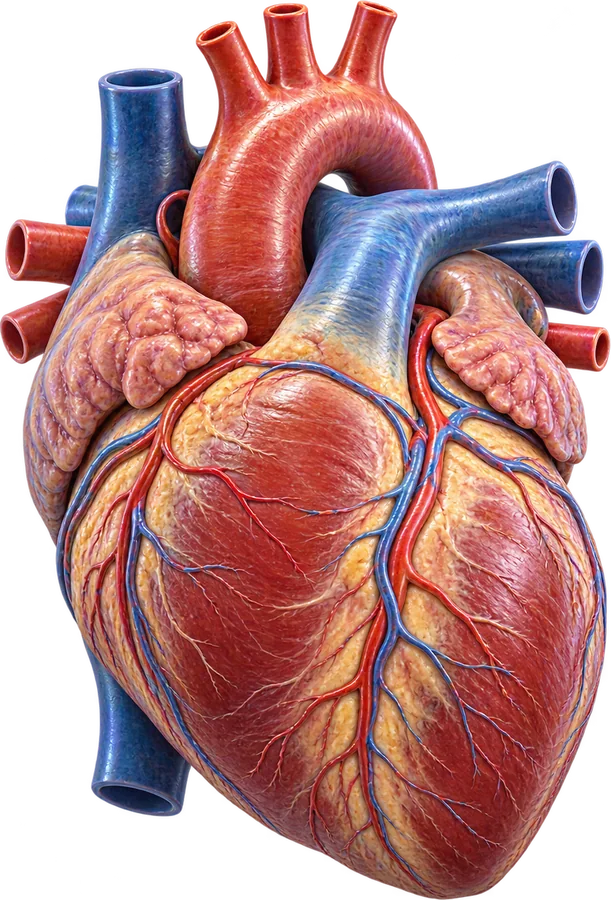
A hollow muscular organ in the chest that pumps blood to the lungs for oxygen and then to the rest of the body.
The heart has four chambers: two atria above and two ventricles below. The right side receives oxygen-poor blood and sends it to the lungs, and the left side receives oxygen-rich blood from the lungs and pumps it to the body. Four valves prevent backflow of blood, and a regular electrical signal coordinates each beat.
The beat begins at the sinoatrial node, then passes through the atria to the atrioventricular node and from it to the ventricles, which contract. The cardiac cycle consists of contraction (systole) and relaxation (diastole). The heart muscle itself is nourished through the coronary arteries, and their narrowing is the essence of coronary artery disease.
What and where is it?
The heart is a hollow muscle located in the chest between the lungs, behind the breastbone and tilted slightly to the left, and it is the centre of the circulatory system.
What it does
| Side | Receives | Pumps to |
|---|---|---|
| Right (right atrium and ventricle) | Oxygen-poor blood from the body | The lungs to exchange gases |
| Left (left atrium and ventricle) | Oxygen-rich blood from the lungs | All body tissues via the aorta |
How it works
- 1The electrical signalBegins in the sinoatrial node, the heart's natural pacemaker.
- 2Contraction of the atriaThey push blood into the ventricles.
- 3ConductionThe signal passes through the atrioventricular node to the ventricles.
- 4Contraction of the ventriclesThe right pumps blood to the lungs and the left to the body, and the valves prevent its backflow.
- 5RelaxationThe heart relaxes and fills again in preparation for the next beat.
The four valves: tricuspid and pulmonary on the right side, mitral and aortic on the left. The heart gets its nourishment from the coronary arteries that branch from the aorta.
Links to other organs
- The lungs
- Blood in them exchanges carbon dioxide for oxygen before returning to the left side of the heart.
- The kidneys
- They take part in regulating blood pressure and fluid volume, so the heart's function is affected by their health and affects it.
- Blood vessels
- Arteries carry blood from the heart, and veins return it to it.
Conditions that affect it
Cardiovascular diseases are among the leading causes of death worldwide according to the World Health Organization.
Tests used to study it
Keeping it healthy
- Not smoking or quitting.
- Regular physical activity: 150 to 300 minutes a week of moderate activity for adults.
- A balanced diet low in salt and unhealthy fats.
- Controlling blood pressure, sugar and blood lipids.
When do you need urgent help?
Call emergency services now 998
- Chest pain or pressure that may spread to the arm, neck, jaw or back, especially with shortness of breath, sweating or nausea — it may be a heart attack.15
Educational content only — no diagnosis, and no substitute for a clinician.
References
- 1NHLBI / NIH. How the Heart Works. www.nhlbi.nih.gov/health/heartHealth agencies & guidelines · Accessed 2026-10-04
- 2NCI SEER Training. Heart. training.seer.cancer.gov/anatomy/cardiovascular/heart/Educational & historical references · Accessed 2026-10-04
- 3NIDDK / NIH. Your Kidneys & How They Work. www.niddk.nih.gov/health-information/kidney-disease/kidneys-how-they-workHealth agencies & guidelines · Accessed 2026-10-04
- 4WHO. Cardiovascular diseases (CVDs) — Fact sheet. www.who.int/news-room/fact-sheets/detail/cardiovascular-diseases-(cvds)Health agencies & guidelines · Accessed 2026-10-04
- 5NHLBI / NIH. Coronary Heart Disease. www.nhlbi.nih.gov/health/coronary-heart-diseaseHealth agencies & guidelines · Accessed 2026-10-04
- 6NHLBI / NIH. Heart Failure. www.nhlbi.nih.gov/health/heart-failureHealth agencies & guidelines · Accessed 2026-10-04
- 7NHLBI / NIH. Arrhythmias. www.nhlbi.nih.gov/health/arrhythmiasHealth agencies & guidelines · Accessed 2026-10-04
- 8NHLBI / NIH. Heart Valve Diseases. www.nhlbi.nih.gov/health/heart-valve-diseasesHealth agencies & guidelines · Accessed 2026-10-04
- 9NHLBI / NIH. Heart Tests. www.nhlbi.nih.gov/health/heart-testsHealth agencies & guidelines · Accessed 2026-10-04
- 10NHS. Electrocardiogram (ECG). www.nhs.uk/tests-and-treatments/electrocardiogram/Health agencies & guidelines · Accessed 2026-10-04
- 11NHS. Echocardiogram. www.nhs.uk/tests-and-treatments/echocardiogram/Health agencies & guidelines · Accessed 2026-10-04
- 12WHO. Physical activity — Fact sheet. www.who.int/news-room/fact-sheets/detail/physical-activityHealth agencies & guidelines · Accessed 2026-10-03
- 13WHO. Healthy diet — Fact sheet. www.who.int/news-room/fact-sheets/detail/healthy-dietHealth agencies & guidelines · Accessed 2026-10-03
- 14WHO. Tobacco — Fact sheet. www.who.int/news-room/fact-sheets/detail/tobaccoHealth agencies & guidelines · Accessed 2026-10-04
- 15NHS. Heart attack. www.nhs.uk/conditions/heart-attack/Health agencies & guidelines · Accessed 2026-10-03
Review status: Edited content · Last updated:
Change log
- — Page created and linked to the 3D atlas.
Educational content only — no diagnosis, and no substitute for a clinician.