Organ2 min read
Lungs
Pulmones
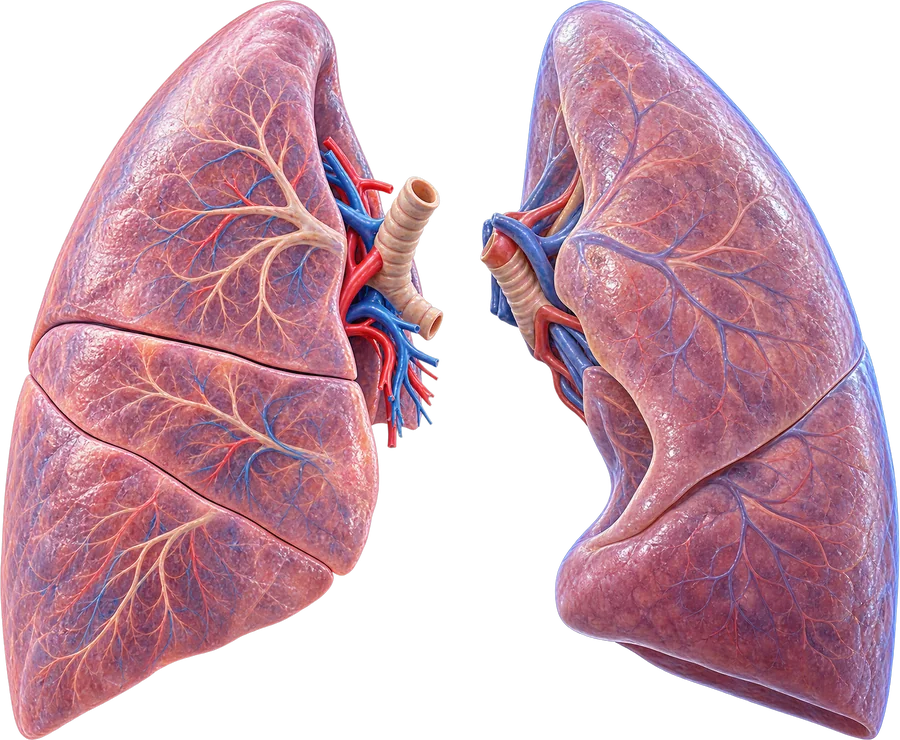
Two spongy organs in the chest that bring oxygen into the blood and remove carbon dioxide with every breath.
Air enters through the trachea, which branches into smaller and smaller bronchi until they end in tiny air sacs called alveoli. The alveolar walls are thin and surrounded by capillaries, and gas exchange takes place in them. Air moves through the action of the diaphragm and the chest muscles.
The right lung has three lobes and the left two to make room for the heart. Oxygen diffuses from the alveoli into the blood and carbon dioxide in the opposite direction by concentration difference. The lungs are protected by mucus and cilia that expel particles, and damage to them, as in smoking, weakens this defence.
What and where are they?
The lungs lie in the rib cage on either side of the heart, above the diaphragm, and are the main organ of the respiratory system.
How they work
- 1InhalationThe diaphragm contracts and lowers so the chest expands and air enters.
- 2The airwaysAir passes from the trachea to the bronchi then the bronchioles.
- 3The alveoliOxygen moves into the blood, and carbon dioxide leaves it.
- 4ExhalationThe diaphragm relaxes so air laden with carbon dioxide leaves.
The blood then carries the oxygen to the left side of the heart to be pumped to the body.
Conditions that affect them
Tests used to study them
Keeping them healthy
- Not smoking and avoiding passive smoking.
- Limiting exposure to air pollution and occupational dust.
- Regular physical activity.
When do you need urgent help?
Call emergency services now 998
- Sudden severe shortness of breath, bluish lips, or inability to finish a sentence.3
Educational content only — no diagnosis, and no substitute for a clinician.
References
- 1NHLBI / NIH. How the Lungs Work. www.nhlbi.nih.gov/health/lungsHealth agencies & guidelines · Accessed 2026-10-04
- 2NCI SEER Training. Respiratory System. training.seer.cancer.gov/anatomy/respiratory/Educational & historical references · Accessed 2026-10-04
- 3WHO. Asthma — Fact sheet. www.who.int/news-room/fact-sheets/detail/asthmaHealth agencies & guidelines · Accessed 2026-10-04
- 4WHO. Chronic obstructive pulmonary disease (COPD) — Fact sheet. www.who.int/news-room/fact-sheets/detail/chronic-obstructive-pulmonary-disease-(copd)Health agencies & guidelines · Accessed 2026-10-04
- 5WHO. Pneumonia — Fact sheet. www.who.int/news-room/fact-sheets/detail/pneumoniaHealth agencies & guidelines · Accessed 2026-10-04
- 6NHLBI / NIH. Cystic Fibrosis. www.nhlbi.nih.gov/health/cystic-fibrosisHealth agencies & guidelines · Accessed 2026-10-03
- 7NHS. X-ray. www.nhs.uk/tests-and-treatments/x-ray/Health agencies & guidelines · Accessed 2026-10-04
- 8NIBIB / NIH. Computed Tomography (CT). www.nibib.nih.gov/science-education/science-topics/computed-tomography-ctHealth agencies & guidelines · Accessed 2026-10-04
- 9WHO. Tobacco — Fact sheet. www.who.int/news-room/fact-sheets/detail/tobaccoHealth agencies & guidelines · Accessed 2026-10-04
Review status: Edited content · Last updated:
Change log
- — Page created and linked to the 3D atlas.
Educational content only — no diagnosis, and no substitute for a clinician.