Organ4 min read
Large intestine
Intestinum crassum
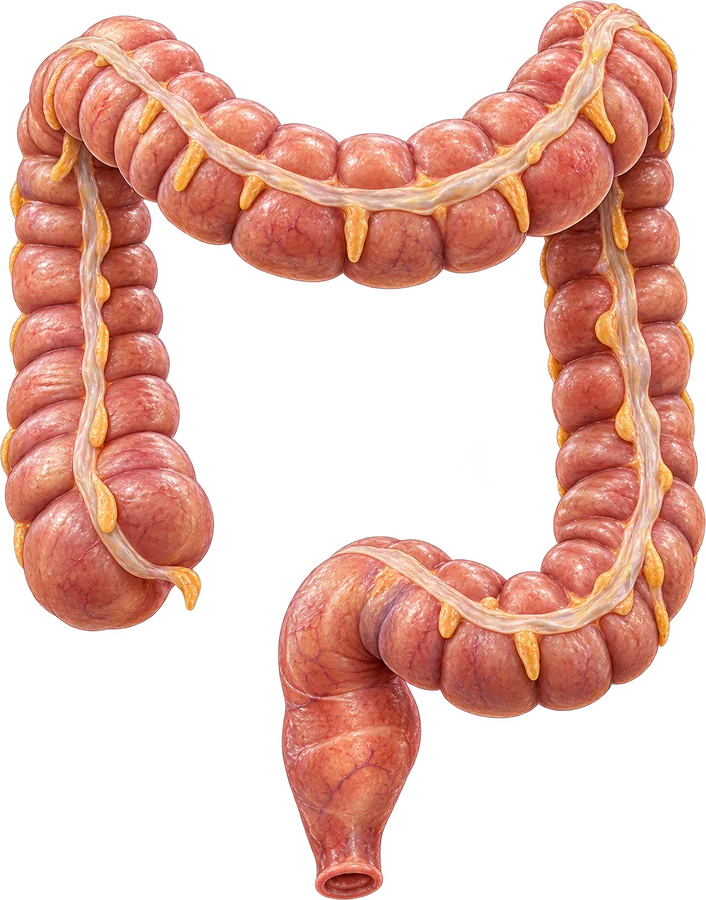
The last part of the digestive tract: a long hollow tube that absorbs water from what is left of food, turns waste into stool and stores it until a bowel movement.
The large intestine is made up of the colon, rectum and anal canal, and is wider than the small intestine. It makes no digestive enzymes — chemical digestion ends in the small intestine — but its bacteria break down remaining nutrients and make vitamin K, and its walls absorb water and salts.
It begins at the ileocaecal junction. Its lining has many goblet cells and no villi. Three longitudinal muscle bands (the teniae coli) gather it into pouches, and fat-filled tags hang from its outer surface. The rectum follows the curve of the sacrum, and the anal canal — the last 2 to 3 cm of the digestive tract — has an involuntary internal sphincter and a voluntary external sphincter.
What and where is it?
The large intestine, which MedlinePlus also calls the colon, is a long hollow tube at the end of the digestive tract where the body makes and stores stool.
It consists of the colon, rectum and anal canal; it begins where the small intestine ends and is wider than it.
What it does
- Absorbing water and salts from what is left of food.
- Turning waste into stool: waste is made of undigested food, fluid and old cells shed from the lining of the digestive tract.
- Breaking down remaining nutrients with the help of bacteria, which also make vitamin K.
- Storing stool in the rectum until a bowel movement.
How it works
- 1ReceptionLeftover food and fluid arrive from the small intestine.
- 2Bacteria at workGut bacteria break down remaining nutrients and make vitamin K.
- 3AbsorbingWater moves from the gut into the bloodstream and the waste becomes stool.
- 4Moving and storingPeristalsis moves stool into the rectum, where it is stored until a bowel movement.
- 5Passing stoolAn involuntary internal anal sphincter and a voluntary external sphincter control the passing of stool.
Common problems that affect it
- Tumours
- Colorectal cancer.
- Colonic polyps: extra tissue growing in the colon that can become cancerous.
- Inflammation
- Ulcerative colitis: ulcers of the colon and rectum.
- Diverticulitis: inflammation or infection of small pouches in the colon wall.
- Functional disorders
- Irritable bowel syndrome: a condition causing abdominal cramping and other symptoms.
Tests used to study it
The colon and rectum are examined from the inside with a colonoscopy:
Keeping it healthy
- The NHS recommends about 30g of fibre a day with enough water: fluid helps waste move through the gut and softens stools, and without it constipation can follow.
- If cereals and grains cause bloating or IBS symptoms, get your fibre from fruit and vegetables instead, says the NHS.
- According to the CDC, quitting smoking lowers the risk of colorectal cancer, and the WHO lists it among the cancers linked to alcohol.
When do you need urgent help?
Call emergency services now 998
- With tummy pain: bloody or black, sticky, foul-smelling stools, or being unable to poo or pass wind.10
Get urgent care today
- Bleeding from your bottom, or diarrhoea that does not go away after a few days.10
Educational content only — no diagnosis, and no substitute for a clinician.
References
- 1MedlinePlus / NLM. Colonic Diseases. medlineplus.gov/colonicdiseases.htmlHealth agencies & guidelines · Accessed 2026-10-11
- 2NCI SEER Training. Small & Large Intestine. training.seer.cancer.gov/anatomy/digestive/regions/intestine.htmlEducational & historical references · Accessed 2026-10-11
- 3NIDDK / NIH. Your Digestive System & How It Works. www.niddk.nih.gov/health-information/digestive-diseases/digestive-system-how-it-worksHealth agencies & guidelines · Accessed 2026-10-11
- 4CDC. About Colorectal Cancer. www.cdc.gov/colorectal-cancer/about/index.htmlHealth agencies & guidelines · Accessed 2026-10-07
- 5NIDDK. Colonoscopy. www.niddk.nih.gov/health-information/diagnostic-tests/colonoscopyHealth agencies & guidelines · Accessed 2026-10-07
- 6MedlinePlus. Endoscopy (Medical Encyclopedia). medlineplus.gov/ency/article/003338.htmHealth agencies & guidelines · Accessed 2026-10-07
- 7NHS. Good foods to help your digestion. www.nhs.uk/live-well/eat-well/digestive-health/good-foods-to-help-your-digestion/Health agencies & guidelines · Accessed 2026-10-11
- 8CDC. Benefits of Quitting Smoking. www.cdc.gov/tobacco/about/benefits-of-quitting.htmlHealth agencies & guidelines · Accessed 2026-10-07
- 9WHO. Alcohol. www.who.int/news-room/fact-sheets/detail/alcoholHealth agencies & guidelines · Accessed 2026-10-08
- 10NHS. Stomach ache. www.nhs.uk/conditions/stomach-ache/Health agencies & guidelines · Accessed 2026-10-11
Review status: Edited content · Last updated:
Change log
- — Page created.
Educational content only — no diagnosis, and no substitute for a clinician.