Organ4 min read
Small intestine
Intestinum tenue
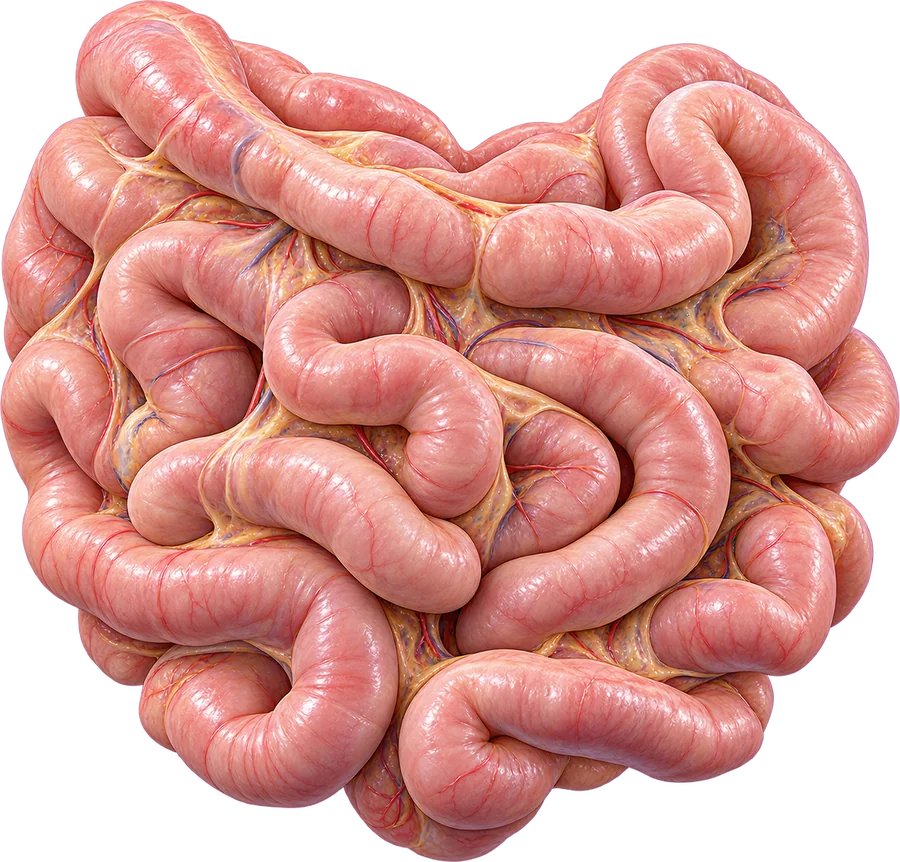
The longest part of the digestive system, linking the stomach to the large intestine; most digestion happens here and most nutrients are absorbed.
The small intestine is about 20 feet (roughly 6 metres) long and folds many times to fit in the abdomen. It has three parts: the duodenum, jejunum and ileum. Its own juice mixes with pancreatic juice and bile to finish breaking down proteins, starches and fats, and its walls absorb water and digested nutrients into the blood.
It runs from the pyloric sphincter to the ileocaecal valve. Circular folds, villi and microvilli increase the absorbing surface. Cells in its lining secrete mucus and enzymes including peptidase, sucrase, maltase, lactase, lipase and enterokinase, and its endocrine cells secrete the hormones cholecystokinin and secretin. Blood carries simple sugars, amino acids, glycerol and some vitamins and salts to the liver, while the lymphatic system absorbs fatty acids and some vitamins.
What and where is it?
The small intestine is the longest part of the digestive system, at about 20 feet (roughly 6 metres). It links the stomach to the large intestine and folds many times to fit inside the abdomen.
It has three parts — the duodenum, jejunum and ileum — and ends at the ileocaecal valve, where the large intestine begins.
What it does
| Function | What happens |
|---|---|
| Finishing digestion | Its muscles mix food with its own juice, pancreatic juice and bile, completing the breakdown of proteins, starches and fats. |
| Absorbing nutrients | Its walls absorb water and digested nutrients into the blood; most nutrients are absorbed here. |
| Moving on what is left | It pushes undigested residue on to the large intestine by peristalsis. |
| Releasing hormones | Its endocrine cells secrete cholecystokinin and secretin. |
How it works
- 1ReceptionChyme arrives gradually from the stomach.
- 2DigestingIntestinal juice, pancreatic juice and bile mix with it, and gut bacteria make some of the enzymes needed to digest carbohydrates.
- 3AbsorbingFolds, villi and microvilli enlarge the surface, and special cells move nutrients across the lining into the blood.
- 4DistributingBlood carries simple sugars, amino acids, glycerol and some vitamins and salts to the liver; the lymphatic system absorbs fatty acids and some vitamins.
Links with other organs
- Pancreas
- Sends its digestive juice to it through ducts.
- Liver and gallbladder
- Bile reaches it to help digest fats, and the liver receives the absorbed nutrients to store and distribute them.
- Large intestine
- Receives what is left of food and fluid.
Common problems that affect it
MedlinePlus lists small intestine problems including bleeding, coeliac disease, Crohn's disease, infections, intestinal cancer, intestinal obstruction, irritable bowel syndrome and ulcers such as peptic ulcer. Treatment depends on the cause.
Tests used to study it
Its first part (the duodenum) is seen with an upper endoscopy, and the rest with a dedicated small-bowel endoscopy (enteroscopy):
Keeping it healthy
- The NHS recommends about 30g of fibre a day from a mix of sources such as wholemeal bread, brown rice, fruit and vegetables, beans and oats.
- It advises drinking enough fluid, especially water, because fibre needs fluid to work.
- Probiotics may help some conditions such as IBS, but there is little evidence for many other claims; talk to a doctor first if you have a health condition or a weakened immune system.
When do you need urgent help?
Call emergency services now 998
- With tummy pain: being unable to poo or pass wind, or bloody or black, sticky, foul-smelling stools.7
Educational content only — no diagnosis, and no substitute for a clinician.
References
- 1MedlinePlus / NLM. Small Intestine Disorders. medlineplus.gov/smallintestinedisorders.htmlHealth agencies & guidelines · Accessed 2026-10-11
- 2NCI SEER Training. Small & Large Intestine. training.seer.cancer.gov/anatomy/digestive/regions/intestine.htmlEducational & historical references · Accessed 2026-10-11
- 3NIDDK / NIH. Your Digestive System & How It Works. www.niddk.nih.gov/health-information/digestive-diseases/digestive-system-how-it-worksHealth agencies & guidelines · Accessed 2026-10-11
- 4NIDDK. Upper GI endoscopy. www.niddk.nih.gov/health-information/diagnostic-tests/upper-gi-endoscopyHealth agencies & guidelines · Accessed 2026-10-07
- 5MedlinePlus. Endoscopy (Medical Encyclopedia). medlineplus.gov/ency/article/003338.htmHealth agencies & guidelines · Accessed 2026-10-07
- 6NHS. Good foods to help your digestion. www.nhs.uk/live-well/eat-well/digestive-health/good-foods-to-help-your-digestion/Health agencies & guidelines · Accessed 2026-10-11
- 7NHS. Stomach ache. www.nhs.uk/conditions/stomach-ache/Health agencies & guidelines · Accessed 2026-10-11
Review status: Edited content · Last updated:
Change log
- — Page created.
Educational content only — no diagnosis, and no substitute for a clinician.