Organ4 min read
Pancreas
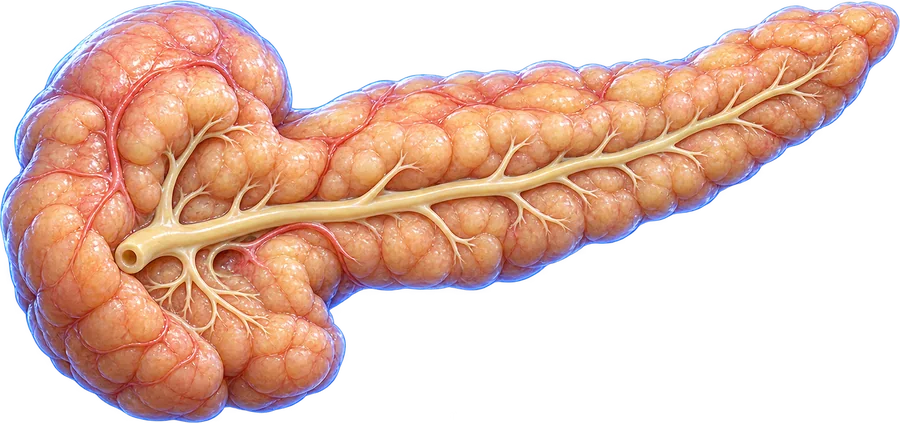
A long gland behind the stomach with two jobs: it makes juices that digest food, and hormones such as insulin that regulate blood glucose.
The pancreas extends horizontally along the back wall of the abdomen from the curve of the duodenum to the spleen. Its larger part, the "exocrine" part, pours digestive enzymes into the duodenum through a duct, and its "endocrine" part consists of small clusters called the islets of Langerhans that secrete insulin and glucagon directly into the blood.
Alpha cells in the islets secrete glucagon when glucose falls, so the liver increases its production, and beta cells secrete insulin when it rises, so its uptake in muscle and fatty tissue and its storage increase. The exocrine part secretes enzymes for starches (amylase), fats (lipase) and proteins, which are secreted in inactive form to be activated inside the intestine; and when they are activated inside the pancreas itself, inflammation occurs.
What and where is it?
The pancreas is a long soft organ in the upper abdomen behind the stomach, extending from the curve of the duodenum (the first part of the small intestine) to the spleen.
It belongs to two systems at once: the digestive system because it makes digestive juices, and the endocrine system because it secretes hormones into the blood.
What it does
| Part | What does it secrete? | Where to? | Purpose |
|---|---|---|---|
| Exocrine (most of the pancreas) | Digestive enzymes | The duodenum through the pancreatic duct | Breaking down starches, fats and proteins |
| Endocrine (islets of Langerhans) | Insulin and glucagon | Directly into the blood | Keeping blood sugar within a suitable range |
How it works
The pancreas regulates blood sugar through a feedback loop that works throughout the day:
- 1After eatingGlucose rises in the blood.
- 2Beta cellsThey sense the rise and secrete insulin.
- 3TissuesMuscle and fat absorb glucose, and the liver stores part of it.
- 4Between mealsWhen sugar falls, alpha cells secrete glucagon so the liver releases stored glucose.
When tissue response to insulin weakens or its secretion falls, this loop is disrupted and blood sugar rises — which is the essence of type 2 diabetes. In type 1, the beta cells themselves are destroyed.
Links to other organs
- Liver and gallbladder
- The liver responds to the signals of insulin and glucagon, and the bile duct meets the pancreatic duct near the duodenum; so gallstones can block the pancreatic duct and cause inflammation.
- Small intestine
- Pancreatic enzymes flow into it so digestion and absorption are completed.
- Muscle and fatty tissue
- They receive the insulin signal to take up glucose.
Conditions that affect it
- Disorders of the hormonal part
- Disorders of the digestive part
- Acute and chronic pancreatitis
- Cystic fibrosis, which blocks the ducts with sticky secretions
- Tumours
Tests used to study it
For its hormonal function:
For its digestive function and its inflammation:
For imaging:
Keeping it healthy
- Maintaining a healthy weight and regular physical activity reduce the risk of type 2 diabetes.
- Avoid alcohol and smoking, which are risk factors for pancreatitis, and smoking is a risk factor for pancreatic cancer.
- Treating gallstones when present under medical supervision, because they are among the most common causes of acute pancreatitis.
When do you need urgent help?
Call emergency services now 998
- Severe, persistent pain in the upper abdomen that may spread to the back, especially with vomiting, fever or a rapid pulse — may point to acute pancreatitis.4
Educational content only — no diagnosis, and no substitute for a clinician.
References
- 1NCI SEER Training. Pancreas — Islets of Langerhans. training.seer.cancer.gov/anatomy/endocrine/glands/pancreas.htmlEducational & historical references · Accessed 2026-10-03
- 2NIDDK / NIH. Your Digestive System & How It Works. www.niddk.nih.gov/health-information/digestive-diseases/digestive-system-how-it-worksHealth agencies & guidelines · Accessed 2026-10-11
- 3NIDDK / NIH. What Is Diabetes?. www.niddk.nih.gov/health-information/diabetes/overview/what-is-diabetesHealth agencies & guidelines · Accessed 2026-10-03
- 4NIDDK / NIH. Pancreatitis. www.niddk.nih.gov/health-information/digestive-diseases/pancreatitisHealth agencies & guidelines · Accessed 2026-10-03
- 5NCI / NIH. Pancreatic Cancer. www.cancer.gov/types/pancreaticHealth agencies & guidelines · Accessed 2026-10-03
- 6NHLBI / NIH. Cystic Fibrosis. www.nhlbi.nih.gov/health/cystic-fibrosisHealth agencies & guidelines · Accessed 2026-10-03
- 7NIDDK / NIH. Diabetes Tests & Diagnosis. www.niddk.nih.gov/health-information/diabetes/overview/tests-diagnosisHealth agencies & guidelines · Accessed 2026-10-03
- 8MedlinePlus / NLM. Lipase Tests. medlineplus.gov/lab-tests/lipase-tests/Health agencies & guidelines · Accessed 2026-10-03
- 9NIDDK / NIH. Preventing Type 2 Diabetes. www.niddk.nih.gov/health-information/diabetes/overview/preventing-type-2-diabetesHealth agencies & guidelines · Accessed 2026-10-03
Review status: Edited content · Last updated:
Change log
- — Organ reference page created.
Educational content only — no diagnosis, and no substitute for a clinician.