Organ4 min read
Bladder
Vesica urinaria
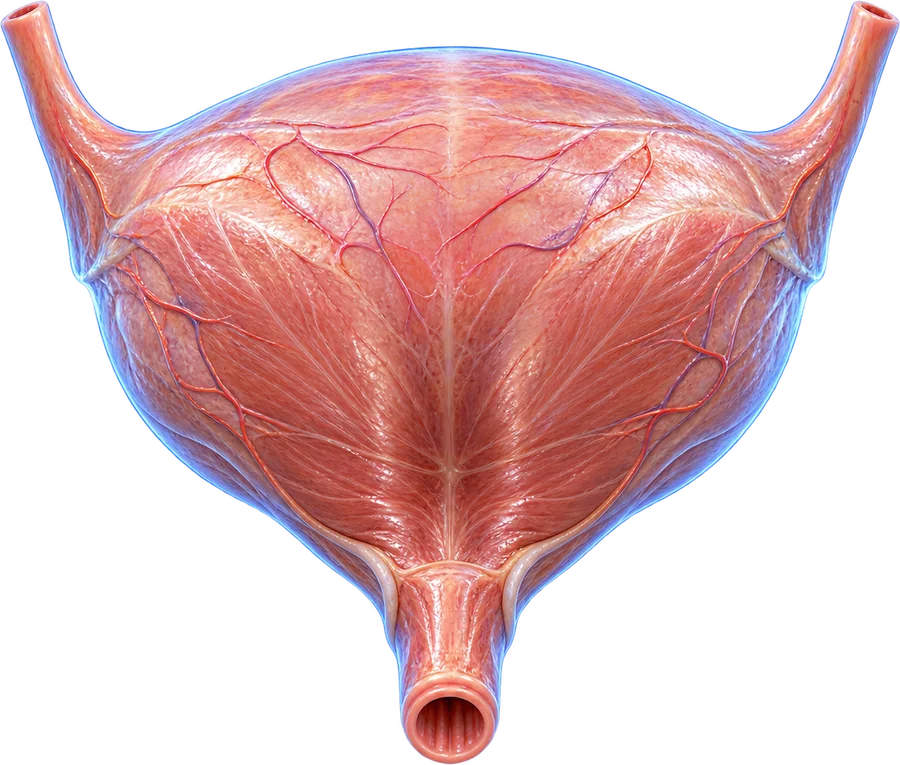
A hollow, muscular, balloon-shaped organ in the pelvis that stores urine from the kidneys and then empties it through the urethra.
Urine reaches the bladder from each kidney through a thin muscular tube called a ureter. Its walls stretch as it fills, and a normal bladder holds about 1.5 to 2 cups of urine. As it fills, signals reach the brain telling you it is time to find a toilet.
Muscles around the bladder neck and urethra — the internal sphincter — stay closed until the brain signals urination; around them, the external sphincter can be squeezed on purpose, with the pelvic floor muscles, to prevent leaks. To urinate, the brain signals the sphincters to relax and then the bladder wall muscle to tighten, pushing urine out through the urethra.
What and where is it?
The bladder is a hollow, muscular, balloon-shaped organ in the pelvis, between the hip bones, that stores urine. It is part of the urinary system.
What it does
- A reservoir for urine: its walls stretch as it fills, and a normal bladder holds about 1.5 to 2 cups.
- Signalling: it sends signals to the brain as it fills.
- Emptying: its wall muscle tightens and pushes urine out through the urethra.
- Preventing leaks: the two sphincters keep the urethra closed between visits to the toilet.
How it works
- 1From the kidneysThe ureters carry urine from the kidneys to the bladder.
- 2FillingIts walls stretch and the internal sphincter stays closed.
- 3SignalThe brain learns that the bladder is filling.
- 4UrinatingThe brain relaxes the sphincters, then tightens the bladder wall muscle, and urine leaves through the urethra.
Common problems that affect it
- Infection and inflammation
- Cystitis: inflammation of the bladder, often from an infection. See urinary tract infections.
- Interstitial cystitis: a long-term problem causing bladder pain and frequent, urgent urination.
- Control problems
- Urinary incontinence: loss of bladder control.
- Overactive bladder: the bladder squeezes urine out at the wrong time.
- Other problems
- Bladder cancer.
- An enlarged prostate can cause a feeling that the bladder has not fully emptied.
Tests used to study it
A doctor can look inside the bladder with a cystoscopy:
Keeping it healthy
- According to NIDDK, most healthy adults should aim for six to eight 8-ounce glasses of fluid a day, at least half of it water. Needs differ for people with kidney stones, kidney failure or heart disease, so ask a clinician.
- Don't hold urine too long: it can weaken the bladder muscles and make complete emptying harder, and leftover urine can let bacteria grow.
- Empty the bladder fully without rushing, urinate after sex, and for women, wipe from front to back.
- Pelvic floor (Kegel) exercises strengthen the muscles that support the bladder, in both men and women.
- Keep your bowels regular with fibre and physical activity, cut back on caffeine and alcohol, and don't smoke; according to the CDC, quitting smoking lowers the risk of bladder cancer.
- Tell a health professional about any change: urinating more often, leaking, trouble starting, or a feeling that the bladder has not emptied.
When do you need urgent help?
Call emergency services now 998
- With urinary tract infection symptoms: confusion, drowsiness or difficulty speaking.3
Get urgent care today
- With urinary tract infection symptoms: blood in your urine, pain in your lower tummy or in your back just under the ribs, or a very high or very low temperature or shivering.3
Educational content only — no diagnosis, and no substitute for a clinician.
References
- 1NIDDK / NIH. The Urinary Tract & How It Works. www.niddk.nih.gov/health-information/urologic-diseases/urinary-tract-how-it-worksHealth agencies & guidelines · Accessed 2026-10-11
- 2MedlinePlus / NLM. Bladder Diseases. medlineplus.gov/bladderdiseases.htmlHealth agencies & guidelines · Accessed 2026-10-11
- 3NHS. Urinary tract infections (UTIs). www.nhs.uk/conditions/urinary-tract-infections-utis/Health agencies & guidelines · Accessed 2026-10-11
- 4NHS. Enlarged prostate. www.nhs.uk/conditions/prostate-enlargement/Health agencies & guidelines · Accessed 2026-10-06
- 5MedlinePlus. Endoscopy (Medical Encyclopedia). medlineplus.gov/ency/article/003338.htmHealth agencies & guidelines · Accessed 2026-10-07
- 6CDC. Benefits of Quitting Smoking. www.cdc.gov/tobacco/about/benefits-of-quitting.htmlHealth agencies & guidelines · Accessed 2026-10-07
Review status: Edited content · Last updated:
Change log
- — Page created.
Educational content only — no diagnosis, and no substitute for a clinician.