Organ3 min read
Kidneys
Renes
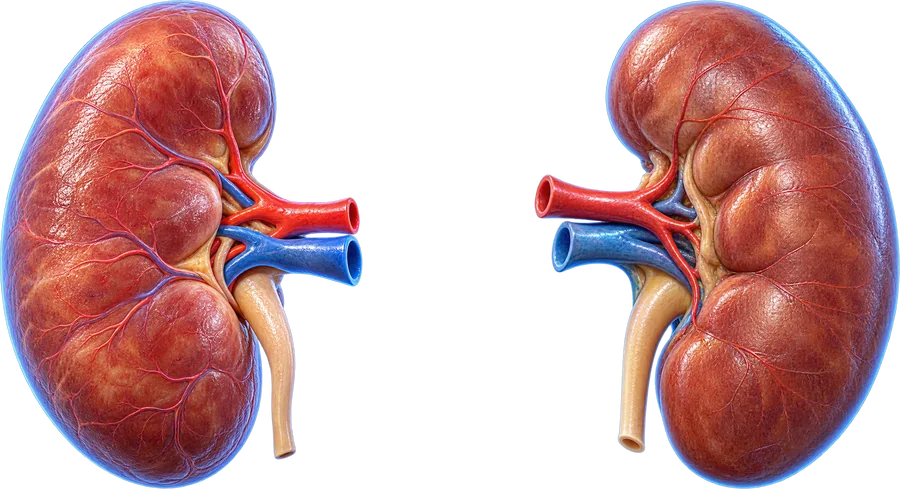
Two fist-sized organs below the rib cage on either side of the spine that filter blood and remove wastes and extra water as urine.
The kidneys filter about 150 quarts of blood a day (roughly 140 litres) to produce between one and two quarts of urine. Each kidney contains about a million filtering units called nephrons. The kidneys make hormones that help regulate blood pressure, produce red blood cells and strengthen bones.
In each nephron the glomerulus filters the blood, then the tubule returns what the body needs of water and salts and expels waste. Filtration performance is estimated by the glomerular filtration rate (eGFR) calculated from creatinine, and the urine albumin test (UACR) reveals early damage to the filters. Diabetes and high blood pressure are the most common causes of chronic kidney disease.
What and where are they?
The kidneys lie below the rib cage on either side of the spine, and are the foundation of the urinary system, and are connected to the bladder by the ureters.
What they do
- Filtering the blood and excreting waste and excess water in the urine.
- Maintaining the balance of water, salts and minerals in the blood.
- Making hormones that help regulate blood pressure, produce red blood cells and keep bones strong.
How they work
- 1Blood arrivalBlood enters the kidney through the renal artery.
- 2FiltrationIn the glomerulus water and small waste pass through, while blood cells and large proteins remain.
- 3ReabsorptionThe tubule returns to the blood what the body needs of water and salts.
- 4UrineWhat remains becomes urine that passes through the ureter to the bladder.
Conditions that affect them
Tests used to study them
Keeping them healthy
- Controlling sugar and blood pressure.
- Regular kidney testing for people with diabetes or high blood pressure.
- Not overusing anti-inflammatory painkillers without consultation.
When do you need urgent help?
Get urgent care today
- Severe flank pain spreading to the lower abdomen with fever or vomiting, or obvious blood in the urine.3
Educational content only — no diagnosis, and no substitute for a clinician.
References
- 1NIDDK / NIH. Your Kidneys & How They Work. www.niddk.nih.gov/health-information/kidney-disease/kidneys-how-they-workHealth agencies & guidelines · Accessed 2026-10-04
- 2NIDDK / NIH. What Is Chronic Kidney Disease?. www.niddk.nih.gov/health-information/kidney-disease/chronic-kidney-disease-ckd/what-is-chronic-kidney-diseaseHealth agencies & guidelines · Accessed 2026-10-04
- 3NIDDK / NIH. Kidney Stones. www.niddk.nih.gov/health-information/urologic-diseases/kidney-stonesHealth agencies & guidelines · Accessed 2026-10-04
- 4NIDDK / NIH. Diabetic Kidney Disease. www.niddk.nih.gov/health-information/diabetes/overview/preventing-problems/diabetic-kidney-diseaseHealth agencies & guidelines · Accessed 2026-10-03
- 5KDIGO. Clinical Practice Guideline for the Evaluation and Management of CKD. kdigo.org/guidelines/ckd-evaluation-and-management/Health agencies & guidelines · Accessed 2026-10-04
- 6NIBIB / NIH. Ultrasound. www.nibib.nih.gov/science-education/science-topics/ultrasoundHealth agencies & guidelines · Accessed 2026-10-04
Review status: Edited content · Last updated:
Change log
- — Page created and linked to the 3D atlas.
Educational content only — no diagnosis, and no substitute for a clinician.