Organ4 min read
Gallbladder
Vesica biliaris
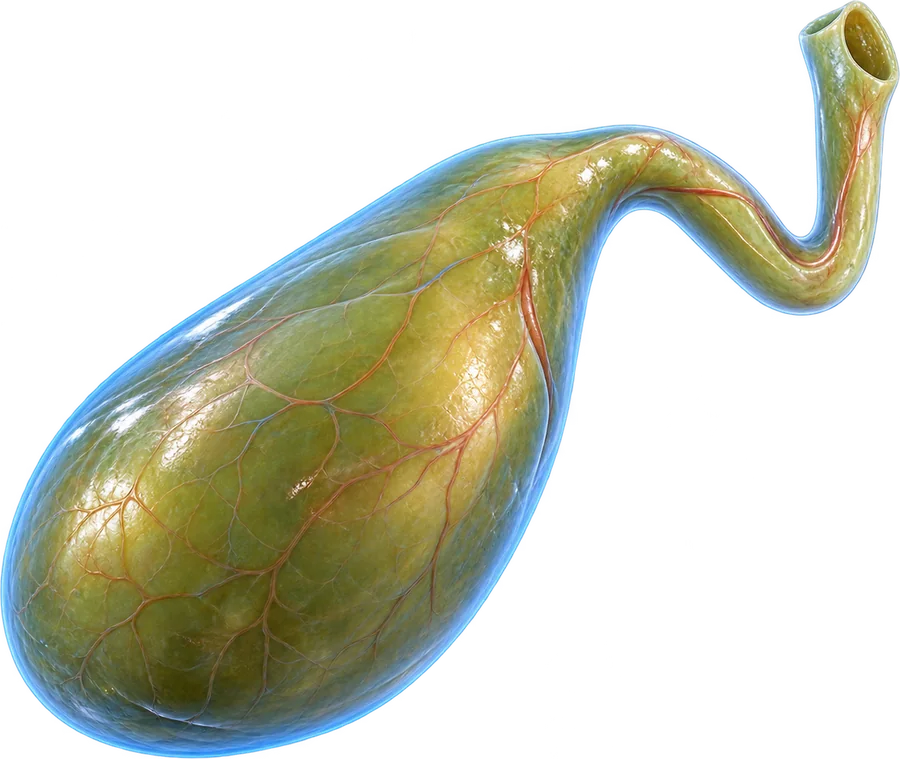
A small pear-shaped organ below the liver in the upper right abdomen that stores bile and releases it into the intestine when you eat, to help digest fats.
The liver makes bile, a digestive fluid made mostly of cholesterol, bile salts and bilirubin. The gallbladder stores it between meals; when you eat, it contracts and sends bile through the bile ducts into the duodenum, the first part of the small intestine. You can live without a gallbladder, because bile reaches the intestine by other routes.
Stones form when bile holds too much cholesterol or bilirubin or too few bile salts, or when the gallbladder does not empty completely or often enough. There are two main types: cholesterol stones, usually yellow-green, and dark pigment stones made of bilirubin. Most gallbladder problems start when something blocks the flow of bile through the ducts — most often a stone.
What and where is it?
The gallbladder is a small, pear-shaped organ below the liver in the upper right abdomen. It is part of the digestive system.
What it does
- Storing the bile the liver makes between meals.
- Releasing it when you eat: it contracts and sends bile through the bile ducts into the duodenum to mix with food.
- Helping digest fats and some vitamins, which is the job of bile.
How it works
- 1LiverMakes bile; the bile ducts carry it to the gallbladder for storage or straight to the small intestine.
- 2Between mealsThe gallbladder stores the bile.
- 3When you eatThe body signals the gallbladder, which contracts.
- 4In the intestineBile reaches the small intestine through the common bile duct and helps digest fats.
Links with other organs
- Liver
- Makes the bile that the gallbladder stores.
- Small intestine
- Bile flows into it to mix with food.
- Pancreas
- A stone can block the duct and cause gallstone pancreatitis.
Common problems that affect it
- Gallstones
- Hard, pebble-like pieces, usually of cholesterol or bilirubin, ranging from a grain of sand to a golf ball in size.
- NIDDK says they are very common, affecting about 10 to 15% of people in the United States, and many people have no symptoms until complications occur.
- Complications of gallstones
- Inflammation of the gallbladder.
- Severe damage to, or infection of, the gallbladder, bile ducts or liver.
- Pancreatitis caused by a blockage from a stone.
- Other problems
- Gallbladder polyps.
- Gallbladder cancer, which is rare.
According to NIDDK, people more likely to develop gallstones include women — especially with extra oestrogen from pregnancy, hormone therapy or birth control pills — older adults, people with a family history, people with obesity or rapid weight loss, and certain conditions such as cirrhosis, diabetes and metabolic syndrome.
Tests used to study it
According to NIDDK, ultrasound is the best imaging test for finding gallstones; CT or MRI may also be used, and blood tests can show signs of infection or inflammation.
When do you need urgent help?
Get urgent care today
- Pain in the upper right abdomen lasting several hours, or with nausea and vomiting, fever or chills, yellowing of the skin or eyes, or tea-coloured urine with pale stools.4
Educational content only — no diagnosis, and no substitute for a clinician.
References
- 1NIDDK / NIH. Gallstones — Definition & Facts. www.niddk.nih.gov/health-information/digestive-diseases/gallstones/definition-factsHealth agencies & guidelines · Accessed 2026-10-11
- 2MedlinePlus / NLM. Gallbladder Diseases. medlineplus.gov/gallbladderdiseases.htmlHealth agencies & guidelines · Accessed 2026-10-11
- 3NIDDK / NIH. Your Digestive System & How It Works. www.niddk.nih.gov/health-information/digestive-diseases/digestive-system-how-it-worksHealth agencies & guidelines · Accessed 2026-10-11
- 4NIDDK / NIH. Gallstones — Symptoms & Causes. www.niddk.nih.gov/health-information/digestive-diseases/gallstones/symptoms-causesHealth agencies & guidelines · Accessed 2026-10-11
- 5NIDDK / NIH. Gallstones — Diagnosis. www.niddk.nih.gov/health-information/digestive-diseases/gallstones/diagnosisHealth agencies & guidelines · Accessed 2026-10-11
Review status: Edited content · Last updated:
Change log
- — Page created.
Educational content only — no diagnosis, and no substitute for a clinician.