Organ3 min read
Trachea
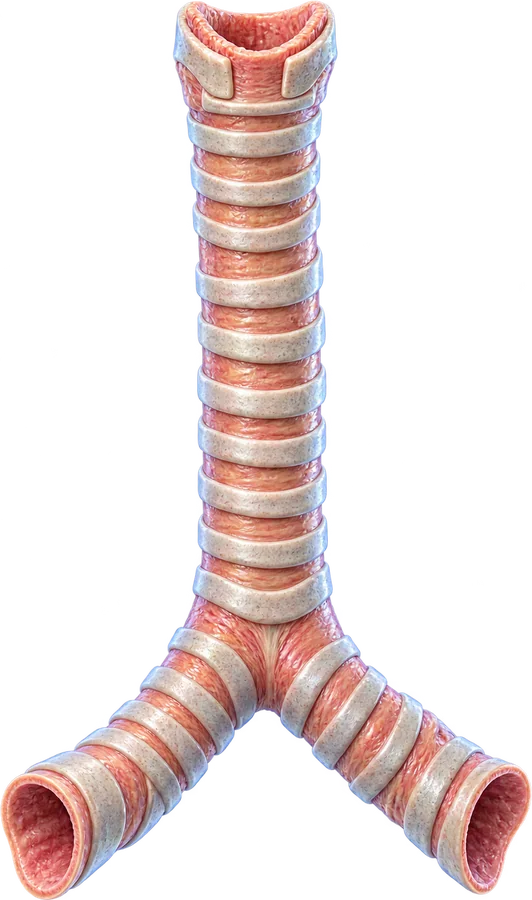
The main airway: a tube that carries oxygen-rich air from the voice box to the lungs and carries carbon dioxide out, before dividing into two bronchi that enter the lungs.
The trachea lies below the larynx, directly in front of the oesophagus. Cartilage in its wall keeps it from collapsing, while its soft back wall lets the oesophagus expand. At its lower end it divides into right and left bronchi that take air to the lungs.
The trachea is lined with ciliated pseudostratified columnar epithelium, like the nasal cavity. Goblet cells make mucus that traps airborne particles and microorganisms, and the cilia sweep the mucus upwards to be swallowed or coughed out. The trachea divides into the two bronchi at the level of the fifth thoracic vertebra.
What and where is it?
The trachea, or windpipe, is the main airway to the lungs and part of the respiratory system. It lies below the larynx, with the oesophagus directly behind it.
What it does
- An air passage: it carries oxygen-rich air to the lungs and carbon dioxide back out.
- Staying open: cartilage supports its wall so it does not collapse.
- Cleaning: mucus traps particles and germs, and cilia push it upwards to be swallowed or coughed out.
How it works
- 1Nose or mouthAir enters and is moistened and warmed.
- 2LarynxAir passes through it into the trachea.
- 3TracheaCarries air downwards while its mucus catches particles.
- 4BronchiAt the level of the fifth thoracic vertebra the trachea divides into right and left bronchi, which enter the lungs and branch into thinner tubes ending in the air sacs.
Links with other organs
- The lungs
- It delivers air to them through the two bronchi.
- Oesophagus
- It lies directly behind the trachea, whose soft back wall lets it expand. When you swallow, the epiglottis drops to keep food out of the airway.
- Thyroid gland
- Its two lobes sit on either side of the trachea, below the larynx.
Common problems that affect it
MedlinePlus lists tracheal problems including narrowing, inflammation and some inherited conditions.
A tracheostomy — a surgical opening in the neck that helps breathing — may be needed for swallowing problems, conditions that affect coughing or airway blockages, or in critical care when a breathing machine is needed.
Tests used to study it
The airways can be seen from the inside with a bronchoscopy:
References
- 1MedlinePlus / NLM. Tracheal Disorders. medlineplus.gov/trachealdisorders.htmlHealth agencies & guidelines · Accessed 2026-10-11
- 2NCI SEER Training. Larynx & Trachea. training.seer.cancer.gov/anatomy/respiratory/passages/larynx.htmlEducational & historical references · Accessed 2026-10-11
- 3NHLBI / NIH. How the Lungs Work — The Respiratory System. www.nhlbi.nih.gov/health/lungs/respiratory-systemHealth agencies & guidelines · Accessed 2026-10-11
- 4NCI SEER Training. Pharynx & Esophagus. training.seer.cancer.gov/anatomy/digestive/regions/pharynx.htmlEducational & historical references · Accessed 2026-10-11
- 5NCI SEER Training. Thyroid Gland. training.seer.cancer.gov/anatomy/endocrine/glands/thyroid.htmlEducational & historical references · Accessed 2026-10-11
- 6MedlinePlus. Endoscopy (Medical Encyclopedia). medlineplus.gov/ency/article/003338.htmHealth agencies & guidelines · Accessed 2026-10-07
Review status: Edited content · Last updated:
Change log
- — Page created.
Educational content only — no diagnosis, and no substitute for a clinician.