Organ5 min read
Spleen
Splen
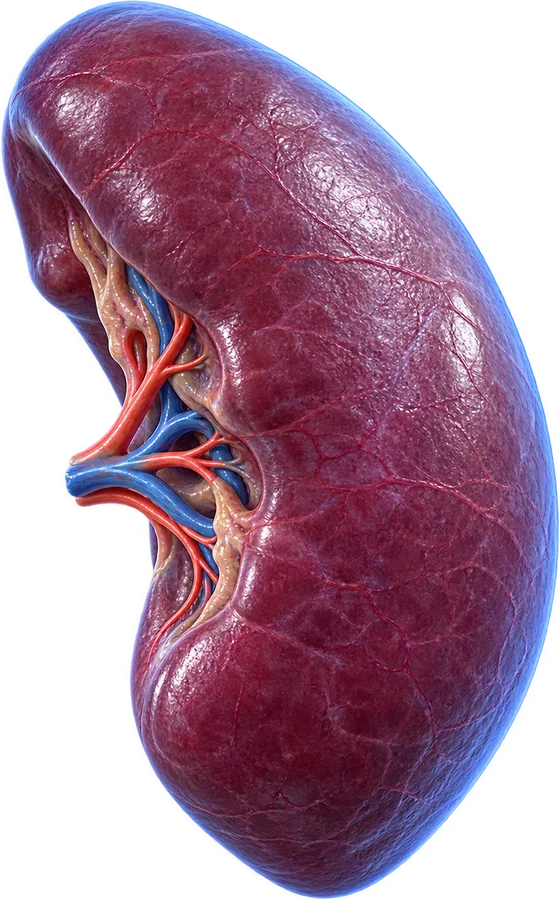
A roughly fist-sized organ in the upper left abdomen behind the ribs that filters the blood, helps fight infection and clears out old red blood cells.
The spleen is the body's largest lymphatic organ and sits beneath the diaphragm, behind the stomach. It holds white blood cells that fight germs in the blood and helps regulate the numbers of red cells, white cells and platelets. You can live without it because the liver takes over many of its jobs, but the body loses some of its ability to fight infection.
Its tissue is made of «white pulp» — lymphatic tissue, mostly lymphocytes clustered around arteries — and «red pulp», venous sinuses filled with blood. Blood enters through the splenic artery, is filtered in the sinuses and leaves through the splenic vein; on the way, lymphocytes react to germs and macrophages engulf debris and damaged cells. The sinuses also store blood, which is pushed into the circulation after bleeding.
What and where is it?
The spleen is roughly the size of a fist. It sits in the upper left abdomen behind the ribs, next to the stomach and just beneath the diaphragm.
It belongs to the lymphatic system, of which it is the largest organ, and works as part of the immune system.
What it does
| Function | What happens |
|---|---|
| Filtering the blood | Blood passes through the spleen's sinuses and is filtered, much as lymph nodes filter lymph. |
| Fighting infection | Its lymphocytes react to germs in the blood, and it makes more of them during an infection. |
| Clearing old cells | Together with the liver, it removes old and damaged red blood cells from the circulation. |
| Regulating blood cells | It helps regulate the numbers of red cells, white cells and platelets. |
| Storing blood | Its sinuses hold blood that can be pushed into the circulation when needed, for example after bleeding. |
How it works
- 1InBlood enters the spleen through the splenic artery.
- 2Red pulpBlood flows through venous sinuses and is filtered; macrophages engulf damaged cells and debris.
- 3White pulpLymphocytes clustered around the arteries recognise germs and try to destroy them.
- 4OutFiltered blood leaves through the splenic vein.
After bleeding, smooth muscle in the vessel walls and in the spleen's capsule contracts and pushes the stored blood into the circulation.
Links with other organs
Common problems that affect it
- Enlarged spleen
- It can follow an infection or injury, or conditions such as cirrhosis, leukaemia and rheumatoid arthritis. It does not always cause symptoms.
- When it does, symptoms can include feeling full very quickly after eating, discomfort or pain behind the left ribs, anaemia and tiredness, frequent infections and bleeding easily.
- Damaged or ruptured spleen
- Usually caused by an injury, such as a blow to the abdomen, a car or sports accident or broken ribs. It can happen straight away or weeks later, and it is an emergency.
- Not working properly
- The spleen may start removing healthy blood cells, leading to anaemia, more infections, or bleeding and bruising, depending on which cells fall.
- Sickle cell disease
- Its emergencies include blood becoming trapped in the spleen (splenic sequestration), a cause of acute anaemia.
Living without a spleen
You can live without a spleen, because other organs such as the liver take over many of its jobs. But the body loses some of its ability to fight infection, and a small lifelong risk remains that a serious infection develops quickly.
- According to the NHS, the risk is higher in young children and in people with sickle cell disease, coeliac disease or conditions that weaken the immune system.
- The NHS recommends extra vaccines, including pneumococcal, a yearly flu vaccine and meningococcal vaccines; the CDC lists Hib, meningococcal and pneumococcal vaccines for people whose spleen is missing or not working. See adult vaccines.
- The NHS also says a doctor may prescribe a long-term preventive antibiotic, and that travellers without a spleen are at higher risk of severe malaria, so they need advice before travelling.
Tests used to study it
A doctor can often feel an enlarged spleen when examining the abdomen; a blood test or a scan confirms it:
When do you need urgent help?
Call emergency services now 998
- Pain behind the left ribs after a blow or accident, with a suspected damaged or ruptured spleen: a ruptured spleen is an emergency.1
Get urgent care today
- For people without a spleen: signs of infection such as a high temperature, sore throat, cough, severe headache, headache with drowsiness or a rash, or abdominal pain.1
Educational content only — no diagnosis, and no substitute for a clinician.
References
- 1NHS. Spleen problems and spleen removal. www.nhs.uk/conditions/spleen-problems-and-spleen-removal/Health agencies & guidelines · Accessed 2026-10-11
- 2NCI SEER Training. Spleen. training.seer.cancer.gov/anatomy/lymphatic/components/spleen.htmlEducational & historical references · Accessed 2026-10-11
- 3MedlinePlus / NLM. Spleen Diseases. medlineplus.gov/spleendiseases.htmlHealth agencies & guidelines · Accessed 2026-10-11
- 4NHLBI / NIH. Sickle Cell Disease. www.nhlbi.nih.gov/health/sickle-cell-diseaseHealth agencies & guidelines · Accessed 2026-10-06
- 5CDC. What Vaccines Are Recommended for You (Vaccines for Adults). www.cdc.gov/vaccines-adults/recommended-vaccines/index.htmlHealth agencies & guidelines · Accessed 2026-10-07
Review status: Edited content · Last updated:
Change log
- — Page created.
Educational content only — no diagnosis, and no substitute for a clinician.