Organ4 min read
Stomach
Gaster
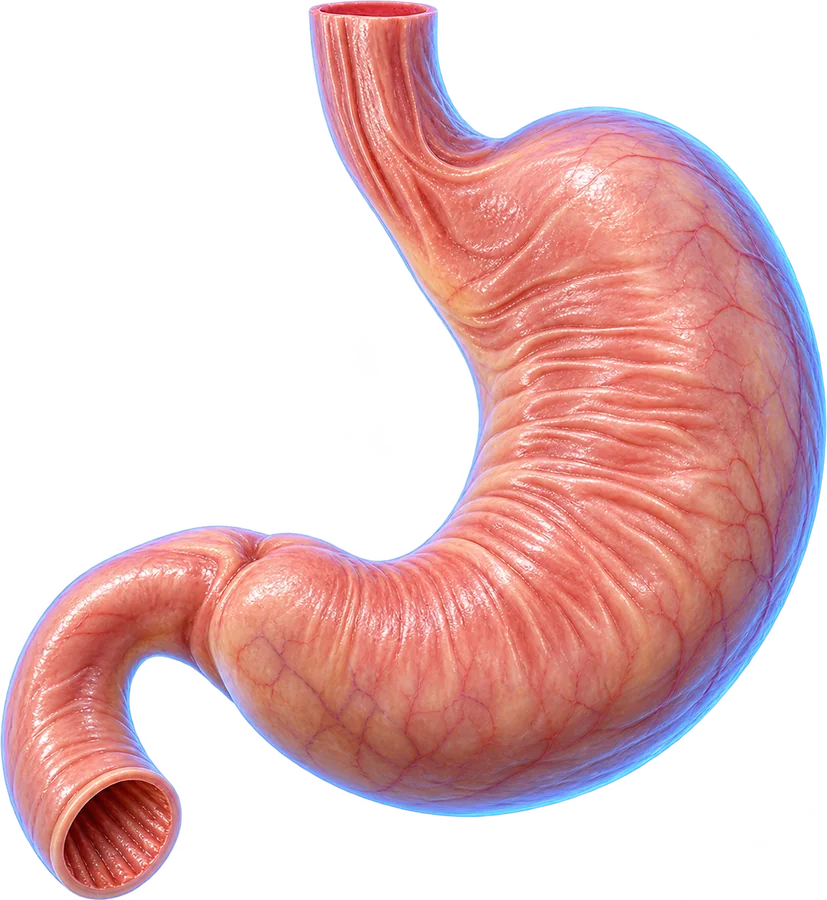
An organ in the upper abdomen between the oesophagus and the small intestine that stores swallowed food, mixes it with acid and enzymes, and starts the digestion of protein.
The stomach lies in the upper left part of the abdomen and receives food from the oesophagus. Its upper muscle relaxes to take the food in, its lower muscle churns it with digestive juices, and it then gradually releases the mixture, called chyme, into the small intestine.
The stomach lining contains tubular glands with four cell types: mucous, parietal, chief and endocrine cells. Secretions from the first three make up gastric juice, while the endocrine cells release the hormone gastrin into the blood to regulate the stomach's activity. Juice is produced continuously, but the amount changes over three phases: cephalic, gastric and intestinal.
What and where is it?
The stomach is an organ between the oesophagus and the small intestine. It lies in the upper left part of the abdomen and is part of the digestive system.
It has four regions: the cardia, the fundus, the body and the pylorus, where the pyloric sphincter sits.
What it does
| Function | How |
|---|---|
| Storing | It stores swallowed food; its upper muscle relaxes to take it in. |
| Mixing | Its lower muscle churns food with digestive juices. |
| Starting protein digestion | Glands in its lining make stomach acid and enzymes that break down proteins. |
| Gradual emptying | It releases the partly digested mixture (chyme) little by little into the small intestine. |
How it works
- 1Cephalic phaseGastric juice starts flowing when you think about or smell food.
- 2Gastric phaseSecretion changes when food reaches the stomach, and the muscles mix it with the juice.
- 3Intestinal phaseAcidic chyme arriving in the small intestine affects the stomach's activity.
- 4EmptyingThe pyloric sphincter relaxes and chyme passes into the small intestine; the rate depends on the chyme and on how ready the intestine is to receive it.
This is controlled by nerve and hormone signals, including gastrin, released by endocrine cells in the stomach lining.
Links with other organs
- Oesophagus
- Carries food to it; the sphincter at its lower end stops stomach contents flowing back.
- Small intestine
- Receives the chyme, where digestion and absorption are completed.
Common problems that affect it
MedlinePlus lists stomach problems including indigestion, heartburn, peptic ulcers and GERD, in which stomach contents flow back into the oesophagus.
It says some of them ease with over-the-counter medicines and lifestyle changes, such as avoiding fatty foods or eating more slowly.
Tests used to study it
A doctor can see the stomach lining directly with an upper endoscopy (oesophagogastroduodenoscopy):
Keeping it healthy
- According to the NHS, fatty and fried foods are harder to digest and can cause stomach pain and heartburn, so it helps to cut back and grill rather than fry.
- Caffeinated drinks can increase stomach acid and cause heartburn, and fizzy drinks can bloat the stomach.
- If spicy food gives you heartburn or stomach pain, cut back; keeping a food diary helps you find your own triggers.
- According to the CDC, quitting smoking lowers the risk of 12 types of cancer, including stomach cancer.
When do you need urgent help?
Call emergency services now 998
- Vomiting blood or vomit that looks like ground coffee, bloody or black, sticky, foul-smelling stools, or sudden or severe stomach pain, or pain when you touch your stomach.9
Get urgent care today
- Stomach pain that gets much worse or does not go away, or comes with problems swallowing food or losing weight without trying.9
Educational content only — no diagnosis, and no substitute for a clinician.
References
- 1MedlinePlus / NLM. Stomach Disorders. medlineplus.gov/stomachdisorders.htmlHealth agencies & guidelines · Accessed 2026-10-11
- 2NCI SEER Training. Stomach. training.seer.cancer.gov/anatomy/digestive/regions/stomach.htmlEducational & historical references · Accessed 2026-10-11
- 3NIDDK / NIH. Your Digestive System & How It Works. www.niddk.nih.gov/health-information/digestive-diseases/digestive-system-how-it-worksHealth agencies & guidelines · Accessed 2026-10-11
- 4NIDDK / NIH. Acid Reflux (GER & GERD) in Adults — Definition & Facts. www.niddk.nih.gov/health-information/digestive-diseases/acid-reflux-ger-gerd-adults/definition-factsHealth agencies & guidelines · Accessed 2026-10-06
- 5NIDDK. Upper GI endoscopy. www.niddk.nih.gov/health-information/diagnostic-tests/upper-gi-endoscopyHealth agencies & guidelines · Accessed 2026-10-07
- 6MedlinePlus. Endoscopy (Medical Encyclopedia). medlineplus.gov/ency/article/003338.htmHealth agencies & guidelines · Accessed 2026-10-07
- 7NHS. Good foods to help your digestion. www.nhs.uk/live-well/eat-well/digestive-health/good-foods-to-help-your-digestion/Health agencies & guidelines · Accessed 2026-10-11
- 8CDC. Benefits of Quitting Smoking. www.cdc.gov/tobacco/about/benefits-of-quitting.htmlHealth agencies & guidelines · Accessed 2026-10-07
- 9NHS. Stomach ache. www.nhs.uk/conditions/stomach-ache/Health agencies & guidelines · Accessed 2026-10-11
Review status: Edited content · Last updated:
Change log
- — Page created.
Educational content only — no diagnosis, and no substitute for a clinician.