Organ4 min read
Thyroid gland
Glandula thyroidea
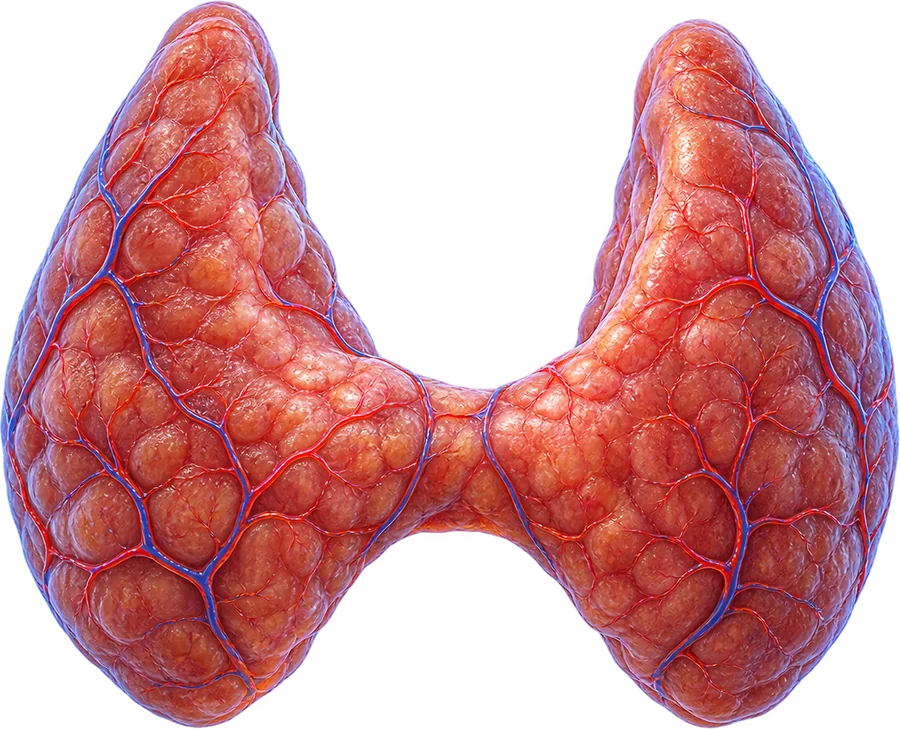
A small butterfly-shaped gland at the front of the neck that makes hormones controlling how the body uses energy, so it affects nearly every organ.
The thyroid sits just below the larynx, with a lobe on each side of the trachea joined by a narrow band called the isthmus. It makes thyroxine (T4) and triiodothyronine (T3), which influence major functions including breathing, heart rate, body weight, digestion and mood. The pituitary gland controls how much it makes, using a hormone called TSH.
The gland is made of follicles that produce the hormones; about 95% of its active hormone is thyroxine and most of the rest is triiodothyronine, and both need iodine. Secretion is regulated by negative feedback between the amount of hormone in the blood, the hypothalamus and the anterior pituitary. Without enough iodine the gland cannot make enough hormone, so the pituitary releases more TSH and the gland enlarges — a simple goitre. Parafollicular cells secrete calcitonin, which lowers blood calcium when it is too high.
What and where is it?
The thyroid is a small, butterfly-shaped gland at the front of the neck, just below the larynx, with a lobe on each side of the trachea joined by the isthmus. It is one of the endocrine glands.
What it does
| Hormone | What it does |
|---|---|
| Thyroxine (T4) and triiodothyronine (T3) | Control how the body uses energy; they reach nearly every organ and influence breathing, heart rate, body weight, digestion and mood. |
| Calcitonin | Released by parafollicular cells when blood calcium is too high, and lowers it until it returns to normal. |
How it works
- 1Pituitary glandReleases TSH, which tells the thyroid how much T4 and T3 to make.
- 2ThyroidUses iodine to make the hormones in its follicles and releases them into the blood.
- 3FeedbackThe pituitary and hypothalamus respond to the amount of hormone in the blood and adjust secretion.
Without enough iodine the gland cannot make enough hormone, so the pituitary releases more TSH and the gland enlarges as it tries to make more — a simple, or iodine-deficiency, goitre.
Common problems that affect it
- Too much or too little hormone
- Hypothyroidism: too little hormone; Hashimoto's disease is its most common cause.
- Hyperthyroidism: too much hormone; Graves' disease is its most common cause.
- Changes in the gland
- Goitre: an enlarged gland.
- Thyroid nodules: lumps in the gland.
- Thyroiditis: swelling of the thyroid.
- Thyroid cancer.
Tests used to study it
Blood tests: TSH is usually checked first — a high level most often suggests an underactive thyroid and a low level an overactive one — and an abnormal result needs at least one more test, such as T4 or T3. Thyroid antibodies help identify autoimmune disorders such as Graves' and Hashimoto's disease.
Imaging: ultrasound is mainly used to look at nodules, and the radioactive iodine uptake test and thyroid scan help find the cause of hyperthyroidism; these two are not done during pregnancy or breastfeeding.
References
- 1MedlinePlus / NLM. Thyroid Diseases. medlineplus.gov/thyroiddiseases.htmlHealth agencies & guidelines · Accessed 2026-10-11
- 2NCI SEER Training. Thyroid Gland. training.seer.cancer.gov/anatomy/endocrine/glands/thyroid.htmlEducational & historical references · Accessed 2026-10-11
- 3NIDDK / NIH. Thyroid Tests. www.niddk.nih.gov/health-information/diagnostic-tests/thyroidHealth agencies & guidelines · Accessed 2026-10-11
- 4NIDDK / NIH. Hypothyroidism (Underactive Thyroid). www.niddk.nih.gov/health-information/endocrine-diseases/hypothyroidismHealth agencies & guidelines · Accessed 2026-10-06
Review status: Edited content · Last updated:
Change log
- — Page created.
Educational content only — no diagnosis, and no substitute for a clinician.